
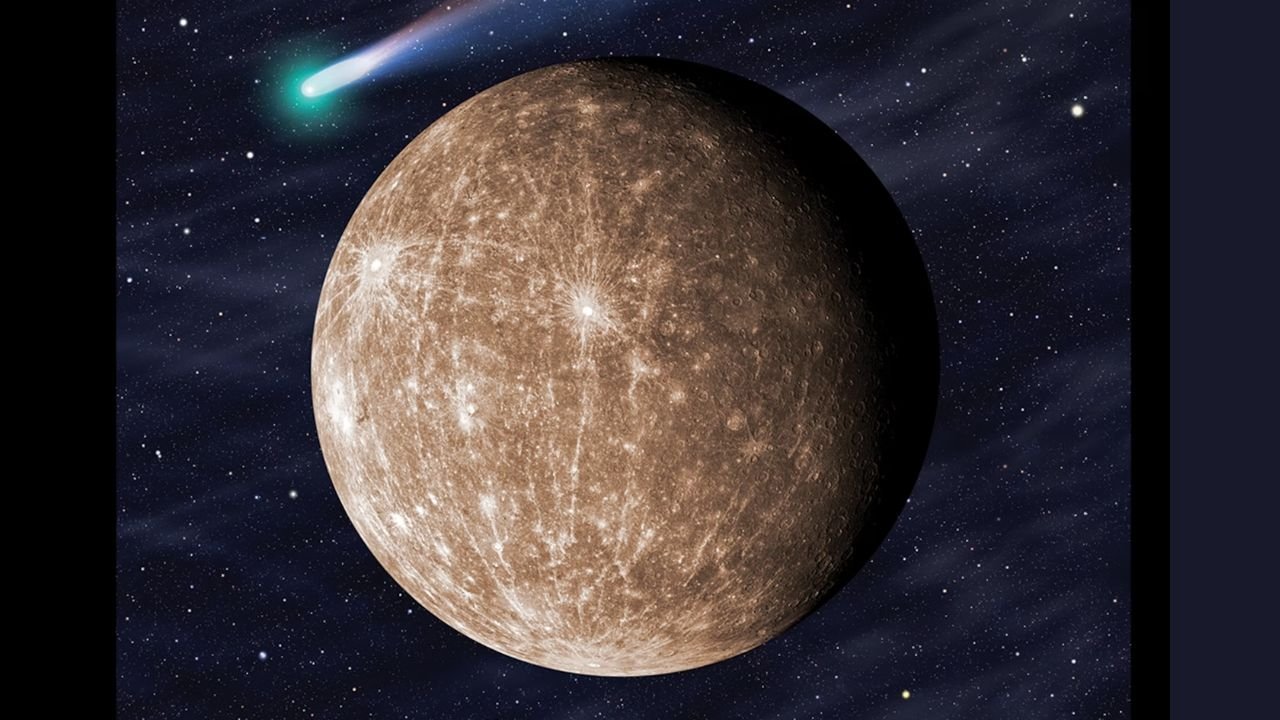
Mercury is one of the most mysterious planets in our solar system. It is tiny, high-performance, and excess pretty much across the board. Scientists have been researching it throughout the decades, but it continues to reveal new things to us. In this article, we will discuss some Interesting facts about Mercury that make it exceptional.
Extreme Temperature Swings
The Mercury has the largest temperature changes in the solar system. The surface gets hot and can reach temperatures of up to approximately 800°F (427°C) during the day. The temperature at night drops dramatically to -330°F (-201°C).
This drastic change occurs due to the absence of an atmosphere on the part of Mercury to store heat. The thin layer around it cannot keep the warmth in after sunset. This makes it a planet of both scorching heat and freezing cold within just 24 hours.
The Smallest Planet in the Solar System
Mercury is designated as the smallest planet. Its radial size is less than 3,032 miles (4,880 kilometers). This is about two-fifths the size of the earth. Mercury is heavy and dense even though it is very small. It has a mass of approximately 5.5 grams per cubic centimeter, and this makes it the second heaviest planet after the earth. This density is attributed to its huge metal-containing interior.
Survivor of a Giant Asteroid Impact
When Mercury was located, scientists feel that it used to be massive in size. There might have been a mega-sized asteroid that hit the planet billions of years ago, sweeping off a large portion of its outer covering. The collision left Mercury with a giant iron core and only thin layer of rocks.This is why it appears so different from other planets. Such an event also shaped its current structure and reduced its size.
An Unusual Orbit
Mercury moves in a strange, elongated path around the Sun. It has the most eccentric orbit among all planets. This means its distance from the Sun changes more than any other planet during its journey.
One year on Mercury lasts only 88 Earth days. However, one day on Mercury (one rotation around its axis) takes 59 earth days. This strange timing produces complicated patterns of light and shadow on its surface.
Ice at the Poles
Even though Mercury is so close to the Sun, ice exists in some parts of the planet. It is located in craters that are always in shadow around the poles. In these craters the temperatures will never exceed -170°C (-274°F). The Sun’s rays never reach these areas, allowing ice to remain frozen for millions of years.
A Massive Iron Core
Mercury’s iron core is huge compared to its size. It makes up about 85% of the planet’s radius. This is much larger in proportion than Earth’s core. The presence of such a core explains its strong magnetic field. Scientists think this field is created by the movement of molten metal inside the planet.
A Thin Atmosphere with a Tail
The atmosphere of Mercury is very thin that it is referred to as exosphere by the scientists. Some concentrations of oxygen, sodium, hydrogen, helium, and potassium can also be found there. The fact that Mercury has a long tail of particles extending into space is among the most interesting facts of Mercury. This “tail” is made of sodium and is pushed away by solar wind.
Magnetic Storms and Tornadoes
Mercury’s magnetic field interacts with the solar wind, creating magnetic tornadoes. These swirling funnels of energy can reach the surface, causing bursts of charged particles. This activity is unusual for such a small planet and makes Mercury more dynamic than many expected.